


Aero Caproni Trento F5
The Aero Caproni Trento F5 was designed by Stelio Frati. It was the second jet aircraft built in Italy after the Fiat G.80, although the latter was considerably more powerful.


La période d’après guerre n’a pas été facile pour la vieille firme italienne CAPRONI. Elle a eu d’énormes difficultés et on a annoncé à plusieurs reprise sa disparition.
With the unveiling of the F.5 under the company’s new name, « Aero Caproni Trento », there was reason to believe it had overcome those difficulties. It is curious that the Caproni name should resurface with a jet aircraft, a form of propulsion the company had been among the first in the world to explore with the Caproni-Campini.
C’est un petit monoplan à aile basse, biplace en tandem, propulsé par un turboréacteur Turbomeca Palas de 150 gp, d’une ligne résolument moderne pour l’époque.
From its very first flight, flown by test pilot Ernesto Zanlucchi on 17 May 1952 at Milan’s Malpensa Airport, there was no doubt that the F5 was a successful design.
Later that day, Zanlucchi and then Vico Rosaspina took the controls and performed a full range of aerobatic manoeuvres, including rolls, loops and spin entries. The F5 demonstrated remarkable manoeuvrability.

The initial flight tests established the following performance figures:
- La vitesse maximum au sol est elle fixée à 360 km.h.
- At 3,000 m, the F.5 easily reaches 315 km/h.
Take-off and landing performance is excellent. Flights on 20 and 22 May showed that the F.5 landed much like the Rondone (the F.4 Rondone, another Stelio Frati design whose landing performance was praised in contemporary advertisements), coming to a stop in less than 300 m without using flaps or brakes.
Official tests conducted by the Italian Veritas established the following landing distances:
- 241 m
- 154 m en se servant à la fois des volets et des freins.
The rate of climb was excellent, considering that the aircraft weighed 750 kg in flying condition and was powered by a turbojet producing just 150 kgf of thrust.
These performance figures were established over numerous flights and confirmed the high expectations for the F5.
Here again, Vico Rosaspina was unequivocal: the F.5 has “the stability and manoeuvrability of a glider”; it is pleasant and very easy to fly, and structurally robust.
In addition to these qualities, its simple, all-wood construction makes it economical and easy to repair. The size and shape of the F.5’s canopy also deserve mention, providing both pilots with excellent visibility. At the rear, the canopy blends smoothly into the fuselage, without any step or break in contour, contributing to the aircraft’s elegant lines. The air intakes have also been designed to leave the wing-to-fuselage junction virtually unobstructed.
Wings
The Caproni F.5 is a low-wing cantilever monoplane, with the wing’s lower surface flush with the underside of the fuselage. The wing has a trapezoidal planform with slightly rounded tips, a slight sweepback and fairly pronounced dihedral beginning at the wing roots.
Fuselage et empennages
The fuselage is an oval-section shell with both simple and box-section frames, covered in birch plywood. It consists of two sections: the forward section houses the cockpit, with two seats in tandem, and supports the nose landing gear; the rear section houses the engine and carries the tail assembly attachment points. The two sections are bolted together.
The conventional tail surfaces are of cantilever construction.


Landing Geard
The aircraft has retractable tricycle landing gear. The nose gear features a long-stroke oleo-pneumatic shock absorber and a steerable wheel controlled by the rudder pedals. It retracts rearwards into the fuselage, with half the wheel remaining exposed when retracted.
Le train principale est fixé en arrière du centre de gravité. Amortissement oléo-pneumatique, frein hydraulique à bras oscillant (la charnière tourne autour du longeron de l’aile). Les roues s’éclipsent vers le plan de symétrie de l’appareil.
The landing gear is retracted mechanically by means of a hand crank mounted on the right-hand side of the front cockpit.


Aircraft built
Only one aircraft was built. This Caproni Trento F.5 is preserved at the Gianni Caproni Museum of Aeronautics in Trento (Museo dell’Aeronautica Gianni Caproni).


Stelio Frati
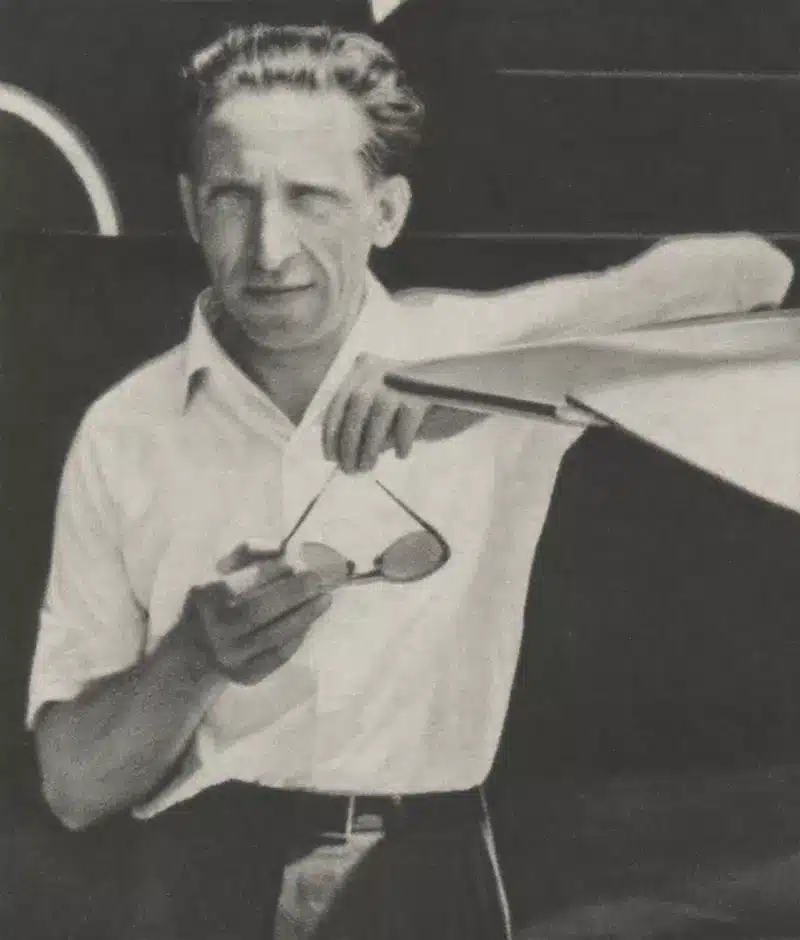
Stelio Frati
Stelio Frati (1919–2010), ingénieur aéronautique italien, a marqué l’aviation légère par des appareils alliant élégance des lignes et performances. Du célèbre Falco aux jets Caproni F.5, Procaer Cobra et FanJet Trainer, ses créations témoignent d’une recherche constante de légèreté et de finesse aérodynamique.